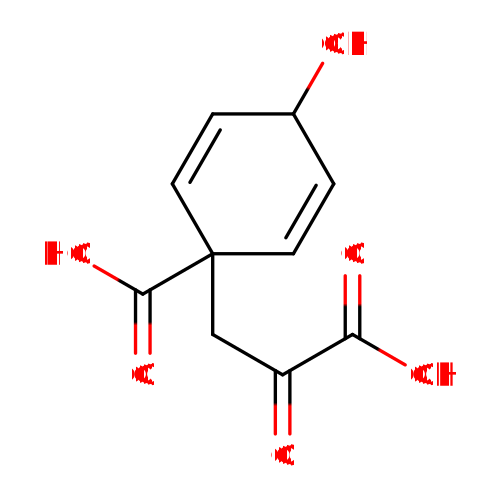
Showing chemical card for Prephenate (CFc000007821)
Record Information
Version
1.0
Creation Date
2022-08-28 10:25:12 UTC
Update Date
2022-09-13 18:54:21 UTC
Chemfont ID
CFc000007821
Molecule Identification
Common Name
Prephenate
Definition
Prephenate (CAS: 126-49-8), also known as prephenic acid, belongs to the class of organic compounds known as gamma-keto acids and derivatives. These are organic compounds containing an aldehyde substituted with a keto group on the C4 carbon atom. Prephenic acid is an example of an achiral (optically inactive) molecule which has two pseudoasymmetric atoms (i.e. stereogenic but not chirotopic centers): the C1 and the C4 cyclohexadiene ring atoms. Prephenate exists in all living species, ranging from bacteria to humans. Prephenate has been detected, but not quantified, in several different foods, such as American pokeweeds, breadnut tree seeds, common wheats, swiss chards, and breadfruits. The other stereoisomer, i.e. trans or, better, (1r, 4r), is called epiprephenic acid. It has been shown that of the two possible diastereoisomers, the natural prephenic acid is one that has both substituents at higher priority (according to CIP rules) on the two pseudoasymmetric carbons, i.e. the carboxyl and the hydroxyl groups, in the cis configuration, or (1s, 4s) according to the new IUPAC stereochemistry rules (2013). It is biosynthesized by a [3,3]-sigmatropic Claisen rearrangement of chorismate. Prephenic acid, commonly also known by its anionic form prephenate, is an intermediate in the biosynthesis of the aromatic amino acids phenylalanine and tyrosine, as well as of a large number of secondary metabolites of the shikimate pathway.
Belongs to the class of organic compounds known as gamma-keto acids and derivatives. These are organic compounds containing an aldehyde substituted with a keto group on the C4 carbon atom.